
MARINE IMMUNITIES & ECOLOGIES : EAR IN A SHELL
Sonic Transcriptions Of Mollusk, Microbial, And Coral Genomes In Marine Soundscapes
Part of larger Conceptual Transplants Collective project presented at:
2025 UN Ocean Conference (Deep Ocean and Ways to Enable Its Sustainable Use), Nice, France.
Collaborative subproject with Christine Paillard (CNRS LEMAR, Brest), Jeremie Brugidou (CNRS-PRISM, Marseille), and the Conceptual Transplants Collective.
Sonification demo (binaural / technical)
This short demo introduces the instrument as a real-time genome spatial mix: multiple DNA-derived note streams and environmental layers are treated as independent sound objects in a binaural 3D scene. The on-screen overlay shows a simplified spatial map in two projections—TOP (left/right/front/back) and SIDE (above/below/front/rear)—so the listener can see where each genomic voice sits as they hear it.
SPATIAL MAPPING (click to expand)
-
- Left: Vibrio tapetis — Chromosome A
- Right: Vibrio tapetis — Chromosome B
- Front: Vibrio tapetis — Plasmid P (virulence-associated)
- Rear: ancient shell-DNA read stream
- Moving field/cloud: coral DNA layer
- Below: granular/spectral Mediterranean (hydrophone/geophone-derived)
This arrangement keeps the host–pathogen topology readable: left/right separates the bacterium’s two chromosomes; front marks the plasmid as an outward-facing mobile element; rear functions as an archaeological “memory axis.” The coral layer(s) complicates this as a moving field rather than a fixed point.
The specific transcription sequence sources are linked at the bottom of this page.
THE SYSTEM: HOW / WHAT? (click to expand)
-
- Breath → opens the sonification gate (the DNA streams speak only while you blow)
- Held wind-synth note → transposes the active pitch window (sets the current root/tonal center)
- Nucleotides (A/C/G/T) → mapped to steps inside that window (within the current window: A lowest … T highest)
- Angle/lean → controls sequence rate (lean back = faster; lean forward = slower)
- Space → each stream has a fixed (or moving) 3D position
Because all genomic streams share the same mapping/scaling, differences you hear across layers come primarily from sequence composition and patterning (repetition vs variation; A/C/G/T bias), rather than from different musical rules for each organism. Timing is quantized as 8th-note triplets (a deliberate rhythmic nod to codon triplets), while tempo stays elastic through tilt control.
LISTENER GUIDE (click to expand)
-
- Direction = identity: left/right/front/rear tells you which genome you’re hearing.
- Repetition vs variation = “sequence fingerprint”: base-biased or repetitive stretches read as insistence or loops; mixed stretches read as contour and shifting shapes.
- Breath = phrase boundary: breath attacks act like punctuation—the genome streams feel exhaled into motion rather than played as fixed clips.
SYMBOLIC / ECOLOGICAL EVOCATIONS (click to expand)
“Ear in a Shell” begins with a childhood gesture: pressing a shell to the ear. The shell re-sculpts listening—an acoustic architecture that filters and bends the outside world into newly patterned sound. I keep doing this with instruments too: placing my ear at the bell of a saxophone, or into its neck, or into a tube of pvc, listening to the room through the instrument’s inner shape—hearing how the world sounds when it has to pass through a body.
Breath completes the circuit: the same air you blow into an instrument, or hold while you listen underwater—the same held breath used to dive for abalones. Here, breath opens the gate—the genome streams only sound while I exhale—so the piece is literally “breathed” into audibility.
The spatial design extends this symbolism into a navigable diagram: DNA is already a kind of palimpsest—copied, overwritten, and revised across generations—so every sequence is a conversation between past bodies, present ecologies, and future adaptations. The rear-placed archival/ancient stream becomes a memory axis in that conversation. The coral layer, by contrast, is treated less as a fixed “voice” than as a broadcast-spawning gamete cloud (a “spawn cloud”): mobile, porous, continuously drifting—suggesting dispersal (spores/gametes), fragility, and biodiversity in motion.
Live performance excerpt (multichannel / embodied)
An 80 second excerpt from the Conceptual Transplants live set, highlighting the Ear in a Shell DNA sonification in performance—interwoven with processed hydrophone recordings. The multichannel audio diffusion and visual synthesis/projection shown here are by Diemo Schwarz.
WHAT THE EXCERPT MAKES AUDIBLE/VISIBLE (click to expand)
-
- “DNA-rpeggios”: nucleotides articulated as rapid arpeggios in rolling triplets, a rhythmic echo of codon (triplet) structure.
- Embodied rate control: my head shifts back to accelerate the DNA read/sonification rate.
- Hydrophone voice-layer: faint underwater singing recorded in the sea with hydrophone, then processed and breath-gated, so it fades in/out with the same gating that opens the DNA streams.
Body and Soul: “Body and Soul” wasn’t a scripted idea: just before the performance, Agnes Callu asked if she might join the performance to sing it—an unexpected addition to the electroacoustic improvisation we had planned. Toward the end of the set I found myself exploring arpeggiating the song’s progression as though it were another DNA sequence stream—a translation of “DNA-rpeggios” into the harmonic skeleton of a standard. In this way, microbial/host code, breath, and a song-form coexist: genomic transcription and conceptual “body and soul” cross-transplanted.
SEQUENCE SOURCES (click to expand)
Vibrio tapetis
(BRD pathogen — spatially positioned on left, right, and front, respectively)
- Chromosome A (Chromosome I): LT960611.1
https://www.ncbi.nlm.nih.gov/nuccore/LT960611.1
https://www.ebi.ac.uk/ena/browser/api/fasta/LT960611.1 - Chromosome B (Chromosome II): LT960612.1
https://www.ncbi.nlm.nih.gov/nuccore/LT960612.1
https://www.ebi.ac.uk/ena/browser/api/fasta/LT960612.1 - Plasmid P (pVT1 / plasmid P): LT960613.1
https://www.ncbi.nlm.nih.gov/nuccore/LT960613.1
https://www.ebi.ac.uk/ena/browser/api/fasta/LT960613.1
Ancient/archival shell DNA read stream
(spatially positioned in rear)
- ENA Project: PRJEB35671 (ERP118760) — “Unveiling the Ecological Applications of Ancient DNA from Mollusk Shells”
- Example run used in notes: Haliotis cracherodii — ERR3712271
https://www.ebi.ac.uk/ena/browser/view/ERR3712271
Direct download urls:
ftp://ftp.sra.ebi.ac.uk/vol1/fastq/ERR371/001/ERR3712271/ERR3712271_1.fastq.gz
ftp://ftp.sra.ebi.ac.uk/vol1/fastq/ERR371/001/ERR3712271/ERR3712271_2.fastq.gz
Mediterranean corals
(coral layer — multiple spatially moving streams)
- Eunicella cavolini (yellow gorgonian) — complete mitochondrial genome: NC_035667
https://www.ncbi.nlm.nih.gov/nuccore/NC_035667?report=fasta
https://www.ebi.ac.uk/ena/browser/api/fasta/KY559408.1 - Paramuricea clavata (red gorgonian) — complete mitochondrial genome: NC_034749
https://www.ncbi.nlm.nih.gov/nuccore/NC_034749?report=fasta
https://www.ebi.ac.uk/ena/browser/api/fasta/LT576167 - Corallium rubrum (Mediterranean red coral) — complete mitochondrial genome: AB700136.1
https://www.ncbi.nlm.nih.gov/nuccore/AB700136.1?report=fasta
https://www.ebi.ac.uk/ena/browser/api/fasta/AB700136.1
BACKGROUND PROCESS
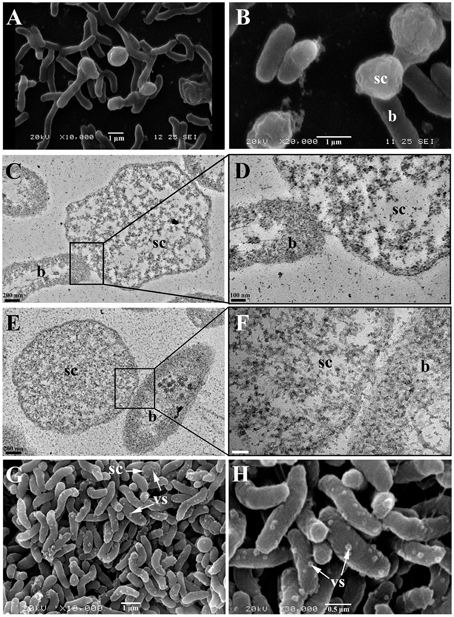
Developed within a broader initiative exploring oceanic knowledge through transdisciplinary practice, Marine Immunities & Ecologies: Ear in a Shell transforms molecular data from marine organisms into immersive biomarine tapestries. With collaboration and guidance from marine biologist Dr. Christine Paillard, and within an interdisciplinary collective of researchers and artists, I created sonic mappings of genomic sequences from Ruditapes philippinarum (a key species in Paillard’s research on Brown Ring Disease (BRD)), alongside a wider constellation of marine and microbial DNA sources.

As a research-creation fellow in oncology and immunology (Institut Cancer et Immunologie and IMéRA), I am interested in how immune logics—recognition, adaptation, evasion—manifest across biological and ecological scales. Paillard’s work on the Ruditapes–Vibrio tapetis relationship offers a compelling immunological framework: a marine host-pathogen system shaped by dynamic exchanges between defense and infiltration—where microbial “intimacies” structure both disease and resilience.
I designed a real-time audio mapping system to sonify a collection of genomic transcriptions from both ancient and modern clam specimens, including Haliotis tuberculata (modern European abalone) and archaeological Ruditapes shells.

These were integrated with sequences from Vibrio tapetis, including its Chromosome A, Chromosome B, and virulence-associated plasmid P—featuring the virB4 Type IV secretion system. Layering Vibrio virulence sequences alongside mollusk host DNA allowed the sonification to stage a kind of microbial proximity: a coexistence of genetic codes entangled through disease, ecology, and time. A sonic architecture shaped by sequences that overlap across species and systems—making audible the ecological entanglements encoded in DNA.
In performance, the system becomes an embodied instrument. I draw from this constellation of sonified sequences—activating and modulating them via breath, motion, and additional sensors connected to a wind synthesizer. This live, embodied interaction was layered with hydrophone recordings captured with Jeremie Brugidou in the Mediterranean, both along the Corniche and in a Marseille kitchen sink! These acoustic recordings were processed through spectral and granular synthesis to develop a mutable, oceanic sonic textural space, resonant with microbial intimacy and environmental entanglement.
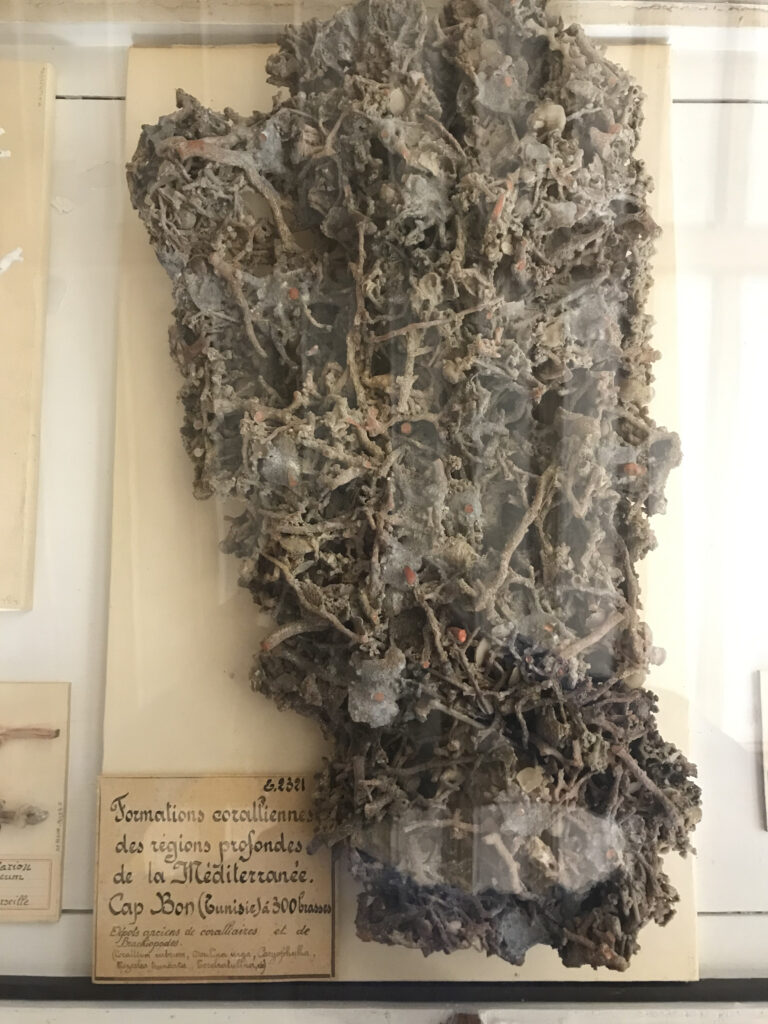
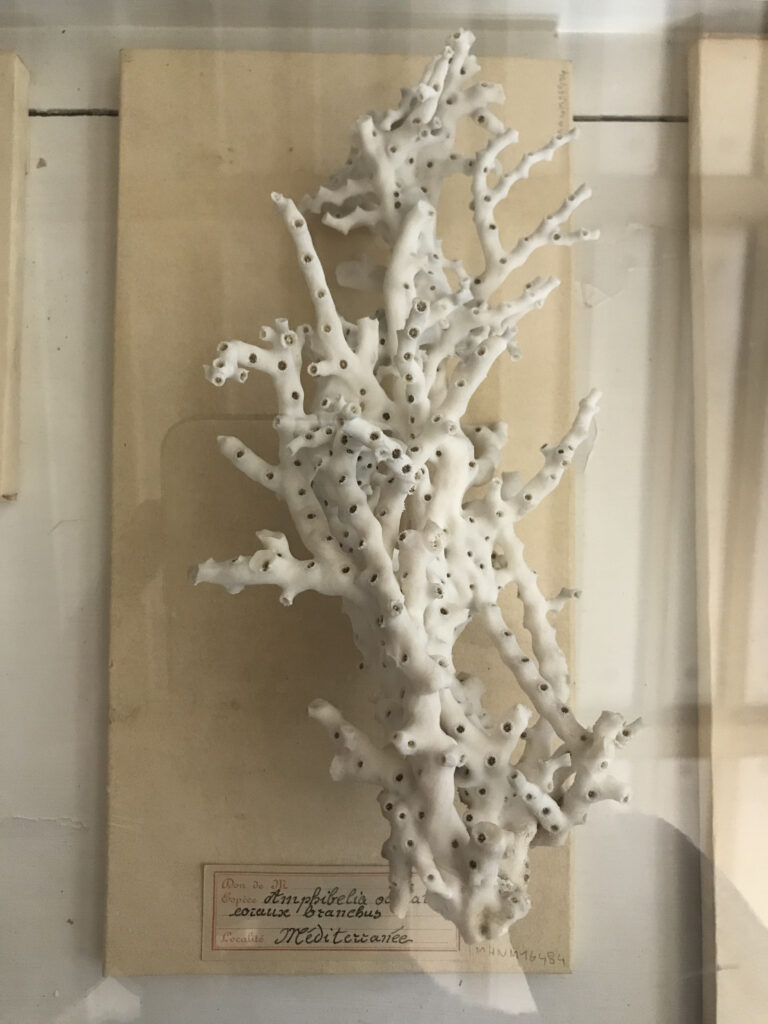
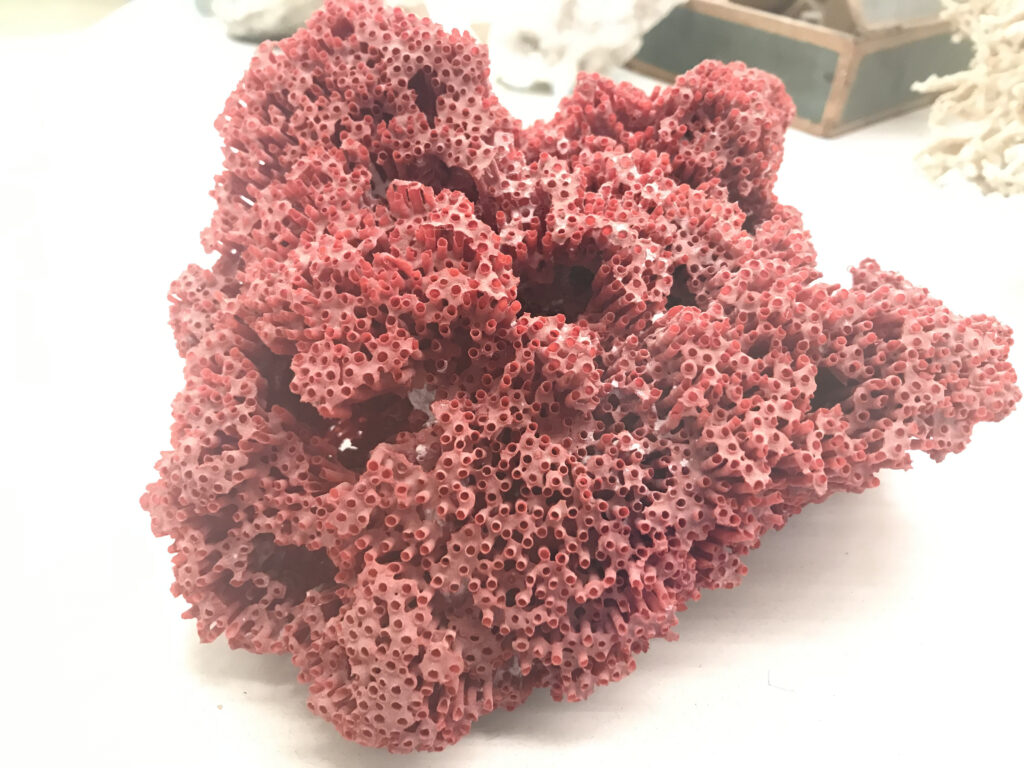
A further dimension emerges through the inclusion of Mediterranean coral genomes, aligned with Conceptual Transplants’ focus on ecological fragility and coral transplantation. Sequences from Eunicella cavolini (yellow gorgonian), Paramuricea clavata (red gorgonian), and Corallium rubrum (Mediterranean red coral) are woven into the system—adding symbolic and ecological complexity anchored in biodiversity and vulnerability.
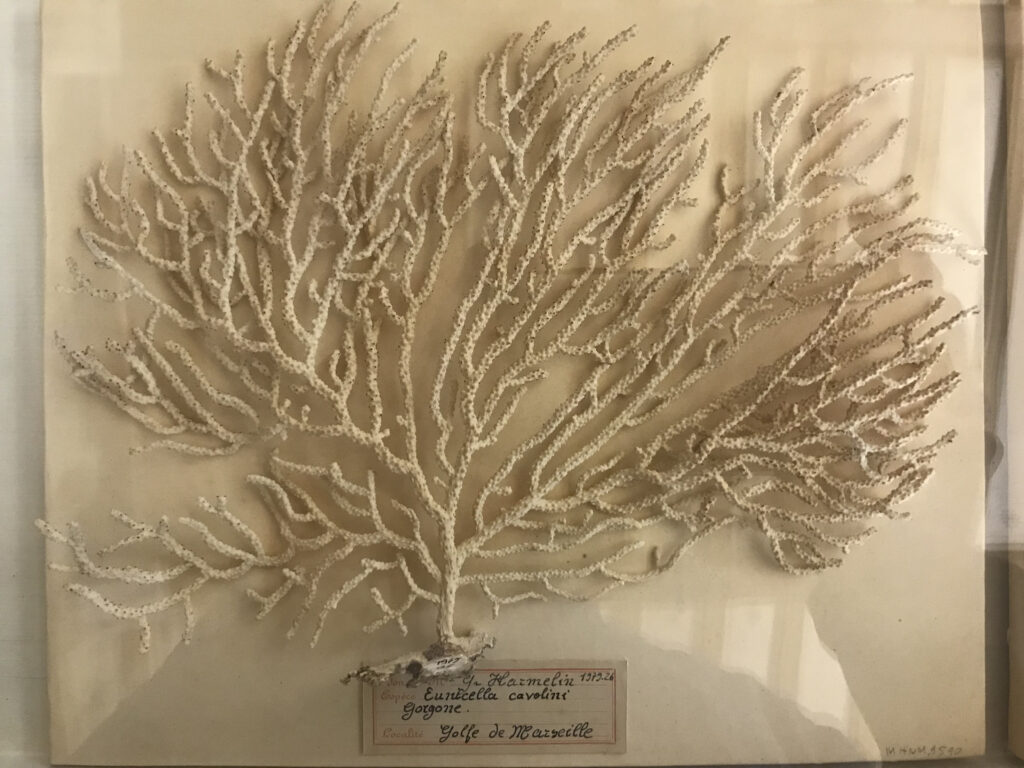
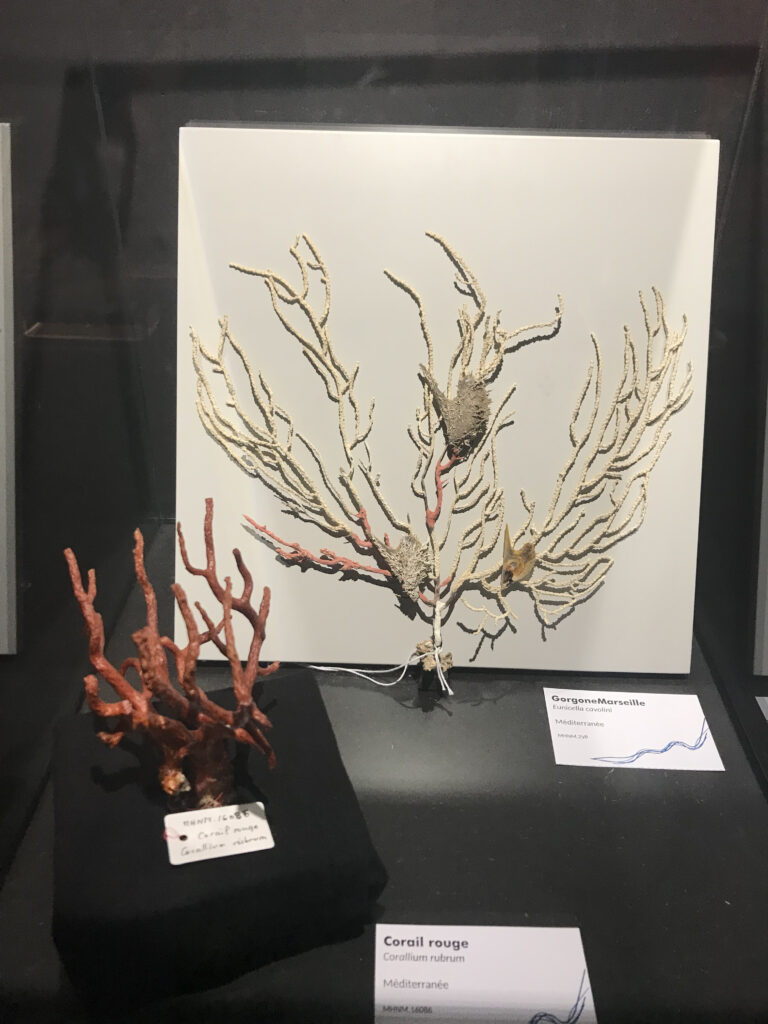
Red coral and yellow gorgonian displayed together. Both species’ sequences were included in the work. (I snapped this pic at the Marseille Natural History Museum nextdoor to my studio office at IMéRA.)

By rendering aspects of host-pathogen interaction and species decline in sound, the work proposes listening as a form of inquiry—one that engages porous boundaries between organism and environment, self and other, sound and structure. The sonification becomes a mode for sensing immunological permeability and ecological entanglement—across genomes, across scales, across time.
IN COLLECTIVE PROCESS, PERFORMANCE & PRESENTATION…
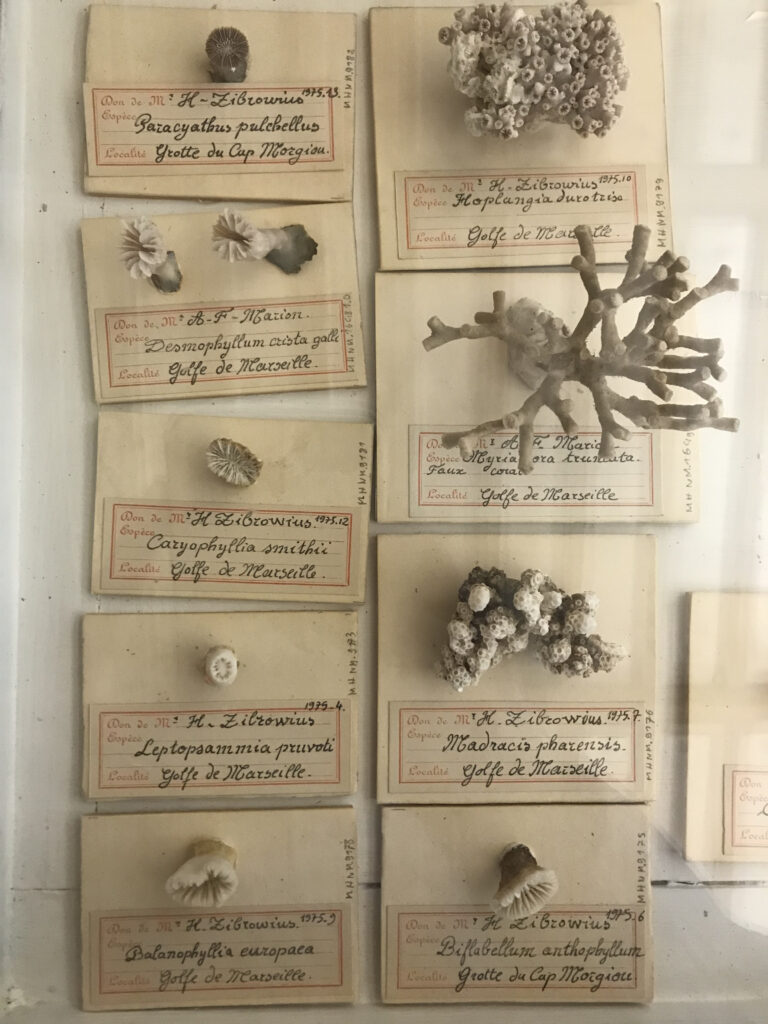
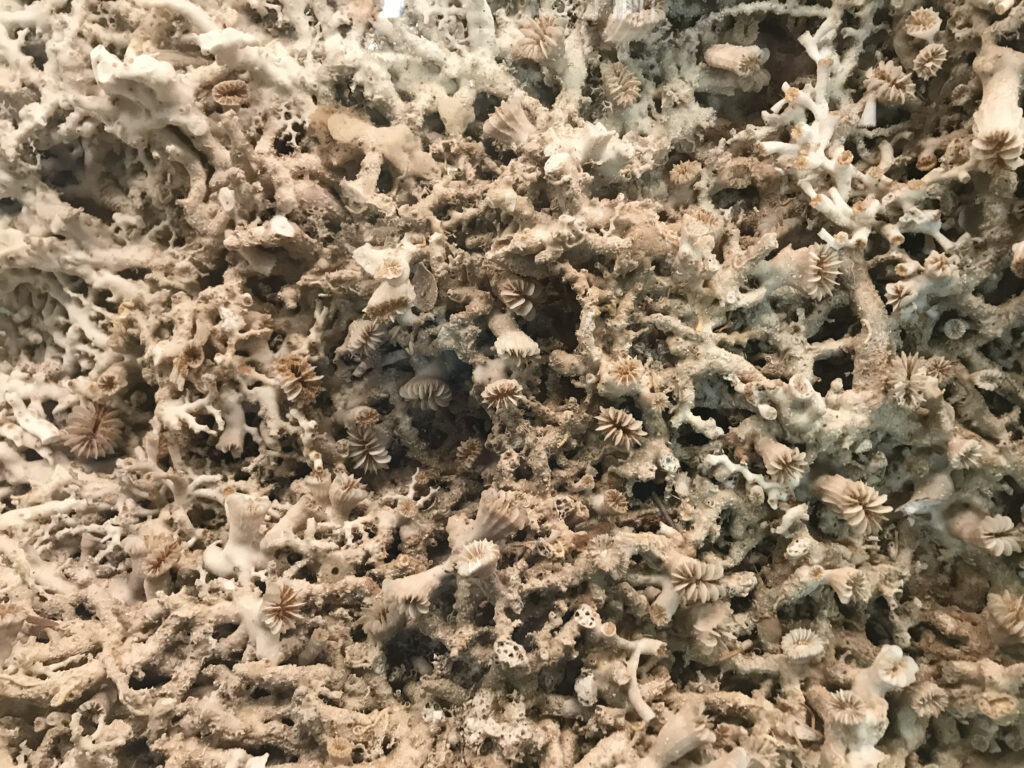
My office studio neighbours the Marseille Natural History Museum where I examined the exhibit and permanent collections, including some of the species whose DNA sequences I sonified (pictured above), here are some other species in the museum displays whose sequences I did not (yet!) sonify…
Selecting genomic data with Christine Paillard in my IMéRA studio…


Capturing hydrophone & geophone audio with Jeremie Brugidou, in the Mediterannean at the Corniches, and in our IMéRA kitchen sink in Marseille…


Showtime… I used the audio & sonification system in a collective electroacoustic audiovisual performance at the Observatoire de Marseille planetarium, with Diemo Schwarz (visual synthesis via CoCAVS, digital and spatial audio; IRCAM), Olympia Boule (voice and percussion), Aline Pénitot (multichannel audio), and Nils Raymond (audio engineering and technical system coordination; IMéRA)…


Conceptual Transdisciplinary collective research…
At SAM (Sea Atmosphere Service) at MIO (Institut Méditerranéen d’Oncéanologie) checking out “Sea Explorer” the French autonomous submarine glider with Diemo Schwarz…

Ocean movement explorations at Camargo (led by Ambra Zambernardi), and mind mapping at IMéRA (pictured L-R: Agnes, Jeremie, Diemo, Olympia, me; pic by Aline)…


The performance was presented live with Diemo Schwarz (visual synthesis via CoCAVS, digital and spatial audio; IRCAM), Olympia Boule (voice and percussion), Aline Pénitot (multichannel audio), and Nils Raymond (audio engineering and technical system coordination; IMéRA). It emerged as part of the Conceptual Transplants Collective—a process-led group committed to shared sensory intelligence, interdisciplinary exploration, and the cultivation of collective imaginaries of the deep ocean.
The system was used in pieces presented at the 2025 UN Ocean Conference (Deep Ocean and Ways to Enable Its Sustainable Use) in Nice, France.
This work was developed within the Ocean/marine biology transdisciplinary collective with:
Agnes Callu (IHTP, l’École des chartes, MAD Paris, l’IIAC – CNRS/EHESS, Paris), Jeremie Brugidou (CNRS, PRISM, Marseille), Olympia Boule, Constance Moréteau (IMéRA), Aurélie Moss (Ecole Nationale Supérieure des Arts Décoratifs), Christine Paillard (CNRS LEMAR, Brest), Aline Penitot, Maria Ptqk, Nils Raymond (IMéRA), Diemo Schwarz (IRCAM), Momoko Seto (CNRS/EHESS, Paris), Lara Tabet, Josune Urrutia Asua (IMéRA), Ambra Zambernardi (Università degli Studi di Torino)